
Feeling Disconnected?
You know your message, you’ve prepared, you want to get it right.
But when you become too focused on saying the right thing, you can lose sight of the people you’re actually speaking to. You stop reading the room, miss the signals that people are confused or disengaging, and often end up explaining more when what’s really needed is connection.
Learn the simple shift that can help you stop communicating at people and start communicating with them.

Shoot Your Shot
Stop overthinking the response before you’ve even delivered the message. Prepare with clarity, trust yourself, and put your point in the room.
Learn how to build composure, confidence and trust without trying to predict every outcome and make a lasting impression.

muddled thoughts cloud your vision?
Good intentions are not the same as clear communication.
In meetings and presentations, I often see people become very clear on what they don’t want to happen. They don’t want to sound pushy, get challenged, upset someone or get it wrong.
The problem? Knowing what you want to avoid doesn’t tell you where you’re trying to go.
Clarity gives your communication direction. It helps you know what you want to achieve, why it matters and what your audience needs to understand.
Because if you don’t know the outcome you’re aiming for, you can spend a lot of energy carefully avoiding the wrong things while still missing the mark.
When Focus Starts Leaking
Under pressure, your attention can quietly shift from communicating to others to managing yourself.
You start thinking about how you sound, what others are thinking, or whether you’re getting it right.
The result? Less connection, less clarity and a lot more effort and you still lose points.
Learn how to notice where your attention has gone, and choose where you want it to go and earn more communication XP.

Your Brain Has Left the Room - The hidden cost of splitting your attention.
Ever been in a conversation while simultaneously having another more anxious one in your head?
Asking yourself, did I make sense? Why did I say it like that? Do they look bored?
That split focus can quietly pull you out of the conversation and make things awkward quickly.
I’ve written a short blog about why this happens, what damaging effect self-monitoring has on your communication, and how to bring yourself back to the person in front of you to connect better and leave happier.
Be Present With the Unpleasant
When pressure hits during a presentation or when public speaking , our instinct is often to escape it. We rush, over-explain and lose connection with the room.
But what if you didn't need to get rid of the discomfort?
What if you could become present with the unpleasant.
Those moments create space between what you feel and how you respond. And in that space, you get something incredibly valuable: choice.
Choose your words. Slow your pace. Reconnect with the room.
Pulled into bad Habits small conversation is where new behaviours begin.
Just this morning, a client texted me: “I knew what I wanted to say, and then it didn’t come out the way I thought it would at all.”
It’s something I hear regularly in my work with people. Knowing what you want to say and actually being able to communicate it when the pressure is on are two very different things.
We often assume the answer is more confidence, more preparation or another communication technique. But what if the real challenge is the gravitational pull of the behaviours we've been practising for years?
Our old patterns have momentum. When the stakes rise, we often fall back into what feels familiar, even when we know there is a better way.
The good news is that new behaviours can develop momentum too.
In this article, I explore why changing the way we communicate takes more than simply knowing what to do, and how small, repeated moments of practice can gradually change our trajectory.
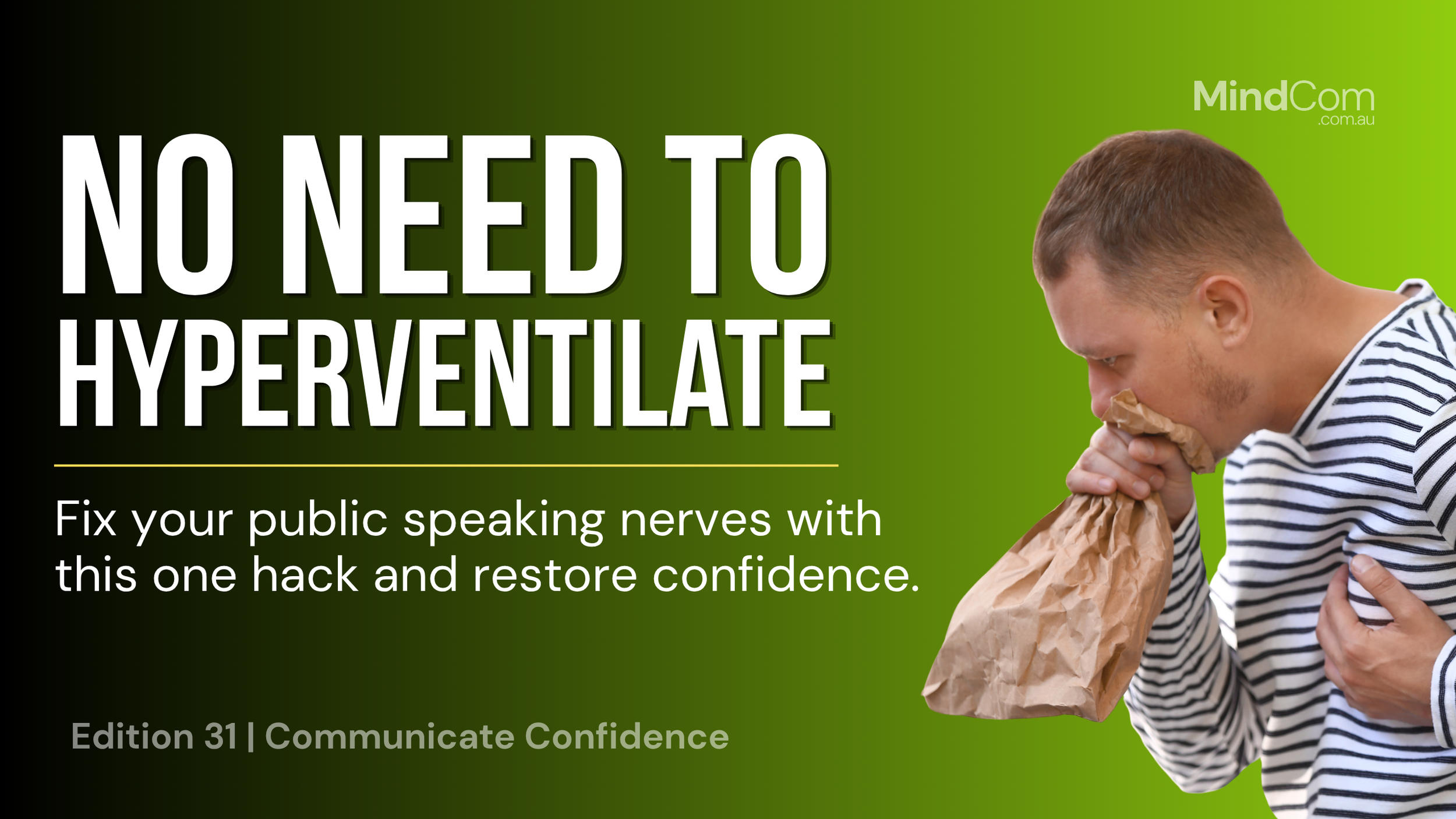
No Need to hyperventilate - When public speaking nerves take over and you’re lost for words, again.
You know what you want to say. You’ve prepared. Then someone asks for your thoughts, and suddenly your heart races, your breathing changes and your words seem to disappear.
What if what you’ve been calling a public speaking confidence problem is actually something much more physical?
Discover the connection between your breath, your nervous system and fix the way you communicate under pressure.

Reaction Gap - Why awareness - not confidence, is the first step to communicating under pressure.
We like to think we're making conscious decisions throughout a conversation or when we are speaking in public, but I suspect many of us are simply watching well-rehearsed patterns unfold. Patterns we've been reinforcing for years without ever questioning whether they're still serving us.
That isn't necessarily a problem. In fact, many of those patterns are incredibly useful and make life easy.
The problem arises when an old pattern takes over before you've had the chance to decide whether it's still appropriate.
Why did I sat that? The Hidden Cost of Overexplaining at Work
Why do intelligent professionals overexplain in meetings or lose their train of though when speaking in public?
It isn't usually a lack of confidence or communication skills.
Discover how attention shifts under pressure, why it changes the way you speak, and a simple mindset shift that leads to clearer, more confident communication.
System Error - Why You’re Struggling to Speak Clearly (And How a Simple Public Speaking Framework Fixes It)
Ever tried to learn something new and felt completely stuck… not because you lacked effort, but because you couldn’t see how the pieces fit together?
That’s the real problem most people face. Not effort. Not intelligence. Structure.
When you don’t understand the system behind a skill, everything feels chaotic. You’re guessing. Reacting. Hoping.
But once the system clicks, progress accelerates almost unfairly fast.
This is true also when speaking in public…

Why You Freeze in Meetings (and How to Always Know What to Say when speaking in public)
Ever been in a meeting or spoke in public and suddenly… your brain just stops? You know you should speak up, but your thoughts spin: “Do I sound smart? What if I miss something? Maybe I should stay quiet.”
For many professionals, it’s not nerves, it’s the lack of a clear frame. Without a simple plan, ideas scatter and confidence drops.
Learn how a small shift, mapping your message before you speak, can help you go from overthinking to owning the room, expressing yourself clearly, and making an impact every time.

Value Tagging: Unlocking the Psychology of Influence when public speaking
Have you ever felt like your emotions are running the show in meetings or presentations, even when you think you’re being logical?
That’s your brain’s value tagging at work, deciding what matters, often unconsciously, before you even realise it.
In this blog, I break down: How your brain tags logic vs emotion. Why the Baader-Meinhof phenomenon makes you notice certain things more than others. How mindful communication helps you show up with composure, clarity, and credibility
If you’ve ever wanted to stop letting old habits control your meetings and start making conscious, high-impact communication choices, this one’s for you.